Seeing a stinging insect near your home can quickly become a concern. wasps vs hornets is a common question because these insects can look very similar. Both can build nests around homes and businesses. Both can sting when they feel threatened. However, their size, markings, nesting habits, and behavior can differ.
Knowing what you are dealing with can help you choose the right solution. Homeowners and business owners can also reduce risk by avoiding active nests and getting professional help when needed. If you need help with an active infestation, you can explore professional pest control services from Metropolitan Pest Service.
Why Correct Insect Identification Matters
Correct identification is the first step toward solving a stinging insect problem.
Different species can choose different nesting locations. Some may build nests under roof edges, while others may use wall voids, trees, sheds, or underground spaces.
Knowing the insect also helps a professional understand the level of risk and choose a suitable treatment method.
Do not approach an active nest just to identify the insect. A photo taken from a safe distance can sometimes help with identification.
Difference Between Wasps and Hornets
The difference between wasps and hornets can be confusing because hornets are part of the larger wasp family.
In everyday language, people often call large wasps hornets. However, scientific classification is more specific. European hornets are true hornets, while bald-faced hornets are actually a type of aerial yellowjacket.
Size can provide a useful clue, but it should not be the only factor.
Body markings, nest shape, nesting location, and insect behavior can provide better information.
How to Recognize Common Wasps
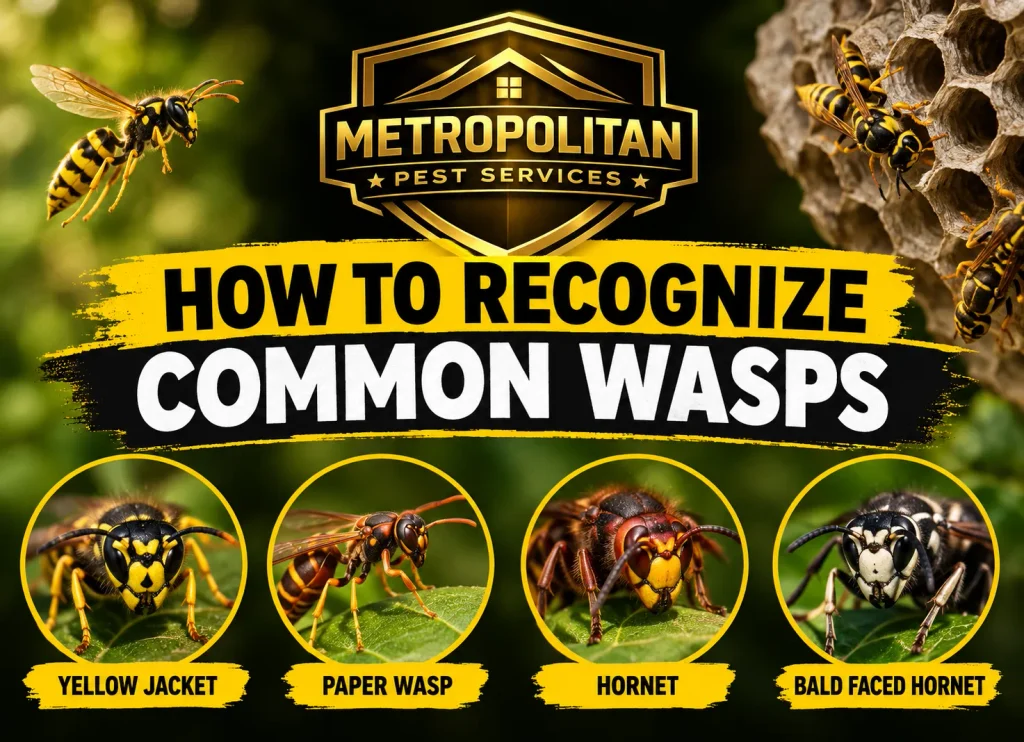
Good wasp identification starts with observing the insect without getting close to it.
Many wasps have slender bodies and a narrow connection between the thorax and abdomen. Yellowjackets often have yellow and black markings. Paper wasps can have longer legs and may show brown, reddish, yellow, or dark coloring.
Common signs include:
- A narrow body with a visible waist
- Yellow, black, brown, or reddish markings
- Activity around food and outdoor drinks
- Nests under eaves or protected areas
- Insects entering cracks or structural openings
Nest appearance can also provide useful clues.
Paper wasps often build open comb nests. Yellowjackets may use wall voids, underground areas, or other protected locations.
How to Recognize Common Hornets
For hornet identification, look at the insect’s size, body markings, and nesting location.
European hornets are large insects with dark brown or reddish-brown coloring and yellow markings. They may build nests inside hollow trees, buildings, barns, and other protected areas.
Bald-faced hornets have black and white coloring. They usually create enclosed paper nests in elevated locations such as trees, shrubs, roof edges, or building structures.
Do not depend on size alone.
Several large wasps can be mistaken for hornets, which is why professional identification can be useful.
Where Wasps and Hornets Build Nests
Wasps and hornets select locations that provide shelter and protection.
Common nesting areas can include roof edges, attics, wall voids, trees, shrubs, sheds, garages, and underground spaces.
Some species may enter through small openings in a building. This can make the infestation difficult to locate from inside the property.
If insects repeatedly enter a wall or ceiling, avoid sealing the opening before the nest is inspected.
What Makes an Active Nest a Problem?
An active colony can become a serious concern when people regularly pass near the nest.
Wasps and hornets may defend their colony when they feel threatened. This can create a greater risk around entrances, patios, playgrounds, restaurants, offices, and busy commercial areas.
Children and pets may also accidentally approach a nest.
Property owners should keep people away from the area until the source has been properly assessed.
When Should You Avoid DIY Nest Removal?
DIY wasp nest removal may seem easy when a nest looks small or distant.
However, an active colony can react quickly when disturbed. Spraying, hitting, shaking, cutting, or removing a nest can cause defensive behavior.
The risk can become greater when a nest is inside a wall, attic, roof area, tree cavity, or another difficult location.
For immediate situations, homeowners can consider same-day pest control assistance instead of taking unnecessary risks.
Professional inspection is especially important when the nest is close to people or located in a hard-to-reach area.
How Professional Hornet Control Works
Effective hornet control should begin with inspection.
A pest professional can identify the insect, locate the nest, evaluate nearby activity, and determine the safest treatment approach.
Professional treatment can be useful for homes, offices, restaurants, warehouses, retail stores, and other commercial properties.
The goal should not only be to address visible insects. The nest and conditions supporting the infestation should also be considered.
Metropolitan Pest Service focuses on practical pest management based on the property’s specific situation.
Safe Stinging Insect Control for Homes and Businesses
Good stinging insect control combines identification, nest management, and prevention.
Property owners can reduce attraction by keeping outdoor food covered, securing trash containers, cleaning food spills, and checking potential nesting areas.
Businesses should pay particular attention to entrances, outdoor dining spaces, dumpsters, loading areas, roof edges, and customer walkways.
If your property has multiple pest concerns, you can review the complete pest control service options to find the most relevant solution.
When to Call a Professional Pest Control Company
A professional wasp exterminator can help when insects repeatedly enter a property or when a nest is located near people.
Professional assistance is recommended when:
- You find an active nest near a doorway.
- Wasps repeatedly enter your home.
- Insects are coming from a wall or ceiling.
- A nest is high above the ground.
- The colony is near customers or employees.
- You are unsure which insect you found.
Metropolitan Pest Service works with residential and commercial properties and can assess the problem before recommending the next step.
NYC Wasp and Hornet Problems Need Local Solutions
NYC wasp control can be important for homeowners, landlords, restaurants, offices, and commercial property managers.
New York properties can provide many potential nesting locations. Roof edges, wall spaces, trees, shrubs, attics, and other protected areas may give stinging insects suitable shelter.
For customers looking beyond one neighborhood, you can review the company’s NYC pest control service areas to understand the locations served.
NYC hornet control also requires careful inspection because large wasp-like insects are not always true hornets.
Metropolitan Pest Service understands that identifying the insect is an important part of creating the right treatment plan.
FAQs About Wasps and Hornets
1. Are hornets and wasps the same insect?
Hornets are part of the wasp family, but not every wasp is a hornet. The term hornet is also sometimes used for certain large wasp species.
2. Are wasps more aggressive than hornets?
Behavior depends on the species and situation. Many social wasps become defensive when their nest is disturbed. It is safest to avoid active nests.
3. How can I tell if a nest is active?
Regular insect movement around the nest usually indicates activity. You may see insects entering and leaving throughout the day.
4. Can wasps build nests inside walls?
Yes. Some species can use wall voids and other protected spaces. Repeated insect activity around a crack or opening may indicate a hidden nest.
5. Should I remove a hornet nest myself?
It is safer to avoid disturbing an active nest. A professional can assess the location and determine the safest approach.
6. When should I contact Metropolitan Pest Service?
Contact Metropolitan Pest Service when you find an active nest near your home or business, notice repeated stinging insect activity, or feel unsure about handling the problem safely.
If you need help protecting your property, contact Metropolitan Pest Service through the website and request professional assistance for your pest problem.
Let Us Take Care
of the Wasp & Hornet Problem
Dealing with an active wasp or hornet nest around your home or business? Metropolitan Pest Service provides professional stinging insect control in NYC to help protect your property and keep your family, customers, and employees safer.
Effective
Service
Commercial
Service Area
NEST